You've Got Mail is a message-in-a-bottle newsletter about change. How it feels, how we navigate it, how we work with others to shape our world, and how we make strategic decisions inside it. Here I share decision-making tools, reflection essays, book recommendations, announcements, and stories to illuminate the threads between systems, change, and the lives we live inside it all.
A report from a land of science-based medicine
Published 8 months ago • 7 min read
January was a month when I spent a LOT of time at the hospital. One week, I was there three times over five days. This is a lot for someone who was 100% not sick. I historically HATE hospitals. Hate. Had some real bad times in them. But, I didn’t mind these visits so much because:
The hospital is a 10 minute bike ride from my house with ample free bike parking and efficient systems that allow me to get in and out quickly.
All the appointments to establish a baseline for my care with doctors who specialize in the particular ways my body functions (aka, MS & cardiology).
The hospital is clean, has natural lighting, and clear signage guiding me directly to each and every place I need to be.
It is all included in my monthly healthcare premium with the exception of the “own cost” deductible I need to meet of…. wait for it…. €385 per year according to the insurance here in the Netherlands.
It was in the service of treatment decisions based on SCIENCE.
The various reasons for each visit included:
Echo cardiogram
MRI of brain and spine
EKG reading
A meeting with the Nurse Practitioner to discuss my infusion protocol and get to know the person who would provide most of my care (Yay)
Meeting the cardiologist who will coordinate my heart care
Shingles Vaccine (YAY)
Flu Vaccine (YAY)
TB Testing (okay, if you must)
A meeting with the desk-nurse to coordinate all of the above
A blood draw to monitor cardiology numbers but also
Multiple blood draws to see if I needed my infusion yet.
Wait up? If I need my infusion yet? If you’ve been following along at home (or if you yourself are one of the 900k people in the US or 80k in Canada or 100k people living in the UK living with Relapsing Remitting MS) you may know that the MS medication that so far successfully keeps me chugging along in life walking, running, talking, typing, breathing, and thinking mostly clearly is an infusion delivered through the vein that kills off half my immune system. It’s now the most commonly prescribed disease modifying medication in the US and Europe.
For me, it’s worked better than anything else I’ve used in the 17 years since I was diagnosed. I’ve been running my life around the calendar of this infusion for more than six years, mapping every single moment of paid sick leave, vacation plans, birthday parties, and writing projects around the six month intervals wherein I would be somewhat incapacitated for anywhere from 3 days to six weeks.
I started taking it in 2019 after a really bad flareup wherein the world spun like a drunken top at all times and I felt like utterly exhausted, agitated, shit.
I was afraid to kill off my immune system over and over again somewhat indefinitely, and then WOAH BUDDY did 2020 just make that fear skyrocket into the ether, forever re-shaping my life and the life of my kids. But, overall, it’s really worked for me and I’m so grateful I’ve had access to the care knowing how unequal access to quality healthcare is in the US and around the world. I was grateful for it despite the dread and frustration that I had to plan my life around it.
Imagine my surprise
And so, imagine my surprise when my new doctor here in the Netherlands — a young woman and doctor-in-training from Belgium — told me that they don’t actually schedule the infusions every six months. Instead, around the six-month-mark they have the patient come in for a blood test. The blood test measures the number of B-cells, the immune cells that are thought to dig spear-holes through the myelin and allow your immune system to attack the brain and spine. If my B-cells are below a certain threshold, I go home, have a nice life, and come back a month later to test again. If and when it’s seen that the B-cells are starting to grow back above a certain (low) threshold, then and only then do they schedule the drip infusion to incinerate the B-cells once again. The internet tells me this approach is called Extended Interval Dosing (EID) or B-cell tailored dosing1.
SCIENCE! NOT SO MUCH PROFIT. SCIENCE.
Each and every time I’ve had an infusion, I received financial assistance from the drug company that produces it2. Because, without it, even though my family’s income was above the national average AND we had private health insurance, we could not afford the medication co-pay. Some years, even with the drug company providing financial assistance, I would pay 3k out of pocket for the services associated with the drug infusion, like sitting my ass in a hospital in Boston looking at their mediocre wall art.
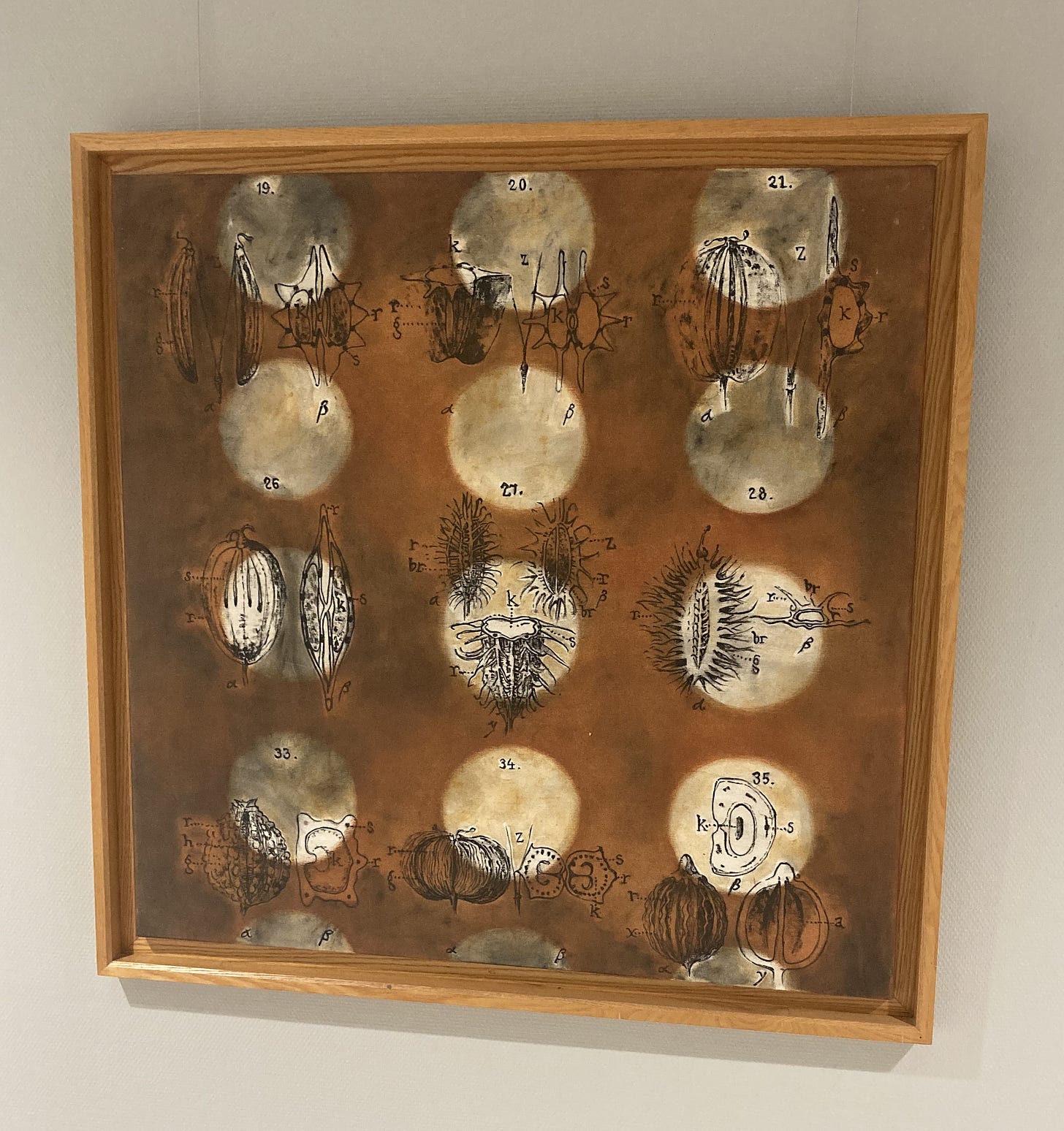
P.S. the hospital art in my local hospital in the Netherlands is grade A, top of the line hospital art. Is this… fruit seeds? Ear drums? Ovum under a colorful shading? Whatever it is, its quality, and I feel confident a real artist was paid for me to soak in the clever vibe of their work on my way to my blood draw.
Eventually the insurance company refused to pay for me to receive the infusion in the hospital, as preferred by my doctor, and they made me to go a strip mall at the edge of working-class towns in my state and the friendly local contracted nurse — the only medical professional at the facility — would set up the drip into my arm while a nice receptionist woman sat out front and other patients came and went for their own infusions. When this happened, my Doctor never received any of the blood tests they supposedly drew and sent off to a remote lab, thereby MYSTERY about my B-cells and also, wasted money and time and blood. Then, when I was done, I would shuffle outside to my car and sit and wait for an hour in the front seat while the sedatives wore off before it was safe for me to drive home. Quality shit, everyone. Quality shit.
The point is, in the US, the protocol in the US was every six months, and profit shaped how, when, and where I received the medication. I very much liked and respected the Neurologist I had at Bingham and Women’s hospital. She hinted at this protocol being an experimental potential in the future, but is it any surprise the US and the drug company was slow-walking a treatment program that put the drug into people’s arms less often? Here in the Netherlands, the land of pragmatism and a public health system rooted in the scientific method, I have so far been granted at least six more weeks of an infusion-free life.
Six blissful and banal life-living weeks
I’ve received an infusion every June and December for the last six years. This meant I started every wintery holiday break with an infusion hangover, suddenly weaker, more exhausted, and at higher risk of infection right at the time most people gather with people they haven’t seen all year. I also planned every summer vacation around this too, scheduling my infusion just before the kids finished school, then usually tacking on my personal time-off to it to extend the amount of time I could go post-infusion without having to kick it into high gear with computer and work tasks.
Hyper-focused thinking and extended screen use is much harder right after my infusion. It feels like the infusion is a chemical garbage collector, moving its giant clunky truck through the tubes of my brain, scratching things up, making everything a little tender and loose-flowing. One does not need to be click-clacking out a work-back-schedule or press release while the brain can feel its own insides. The quickest recovery times I’ve had post-infusion are times when I allow myself ample time to read books, putz around my yard, and chill out — a skill at which I am generally quite inept. The times I’ve launched right back into work a day or two after my infusion, the effects of the infusion have dragged on for five or six weeks, making me a shell-person for an entire season.
So, this is to say, that when I went for the blood test in January, I felt like I had already won. The time it took to set up my doctors after getting health insurance in the Netherlands pushed me past my potential infusion timeline of December. I didn’t have a flareup — the very thing the infusion is supposed to head off — in that month. And when I learned in January that I could potentially put it off ANOTHER month, I was jazzed.
In that time I’ve:
Started a couple of advertising experiments (BORING. NECESSARY).
Pitched my new city’s innovation grant to fund a project I’m working on with my wife and our friend.
Each week is a gift and I’m glad to have it. I test again next week, and who knows, maybe like a groundhog I will get four more weeks of (infusion-free) winter. As I watch the federal government in my home country prevent regular people from getting life-saving medications and vaccines,3 the contrast remains stark. Scientific research. Quality universal healthcare. They can make great things happen. They’re worth fighting for.
If you’re considering leaving the US (even if flashes of “what if” or “I couldn’t!” cross your mind occasionally) my wife Nova and I wrote a book just for you. Get $2 off the PDF download when you use the code NEWSLETTER at checkout after you click the green button below.
You've Got Mail is a message-in-a-bottle newsletter about change. How it feels, how we navigate it, how we work with others to shape our world, and how we make strategic decisions inside it. Here I share decision-making tools, reflection essays, book recommendations, announcements, and stories to illuminate the threads between systems, change, and the lives we live inside it all.