You've Got Mail is a message-in-a-bottle newsletter about change. How it feels, how we navigate it, how we work with others to shape our world, and how we make strategic decisions inside it. Here I share decision-making tools, reflection essays, book recommendations, announcements, and stories to illuminate the threads between systems, change, and the lives we live inside it all.
Back to school in a whole new country: Part 2
Published about 1 month ago • 11 min read
Well, it's almost fall time and the blissful cool breeze finally arrived after a long hot summer. Last night I sat down at a long beige table and realized, with a mixture of wonder and nerves, “oh wow, I am about to sit through an entire hour of being talked to about my kid and not understand a single word!”
It’s back to school season and we’re starting the second year of life in the Netherlands and new schools for both kids. Last year, I teared up as my kids (then 10 + 12) joined a sea of un-helmeted young people biking throughout the city to their respective schools. My kids’ school was the city’s only International School and the only English-language education in town.
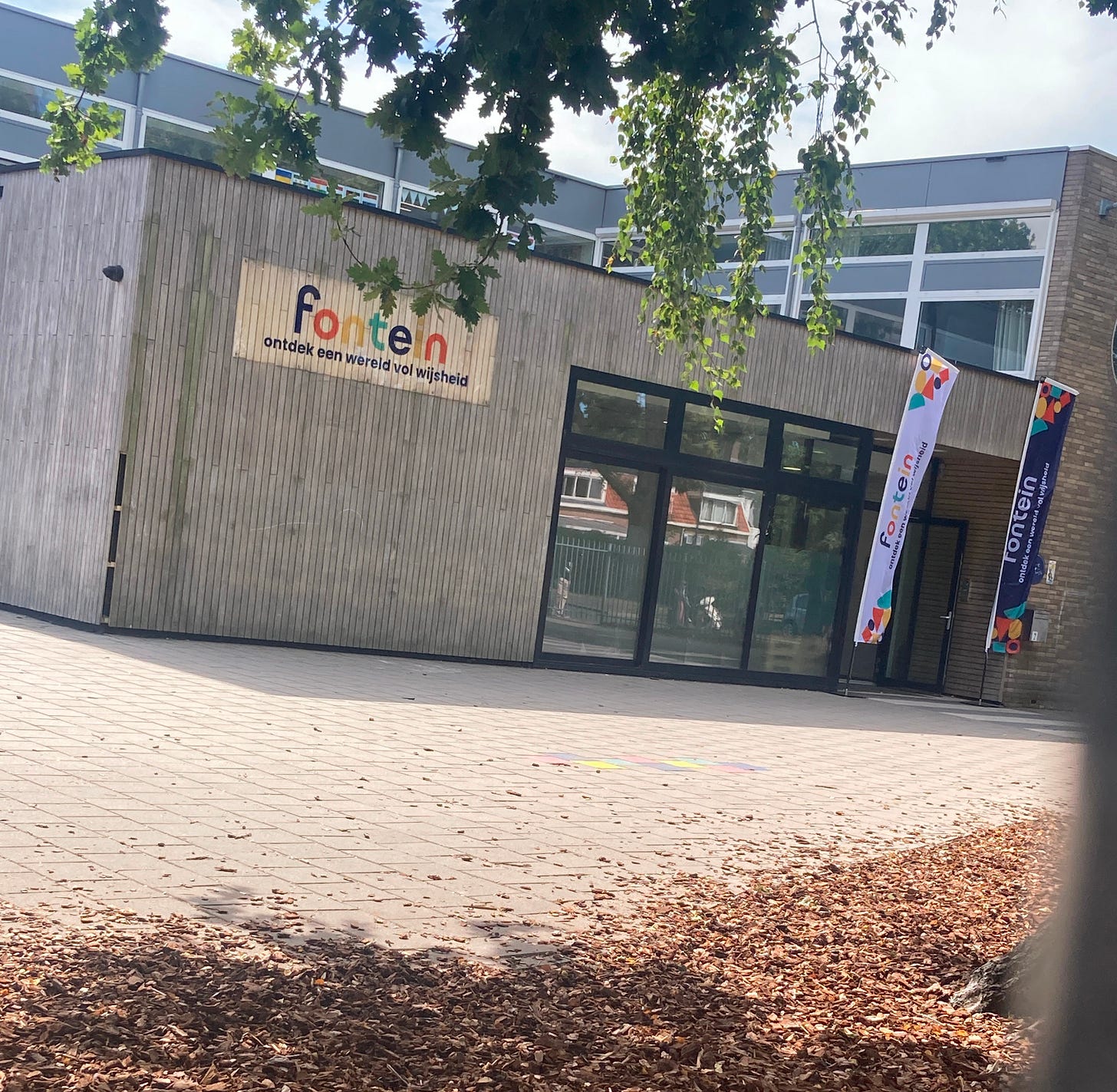
This year, I biked the littlest one along a fully protected bike path, high-fiving the wildflowers, over the international train tracks, and to her new small, unimposing, two-story elementary school. It is rectangular and average and the playground was buzzing with kids running this way and that as I wove from one teacher to the next— each of them holding a ceramic mug of coffee (somehow it’s hard for me to picture this happening on an American playground)—saying to each of them, “Ik kiken de docent of Kameleon,” in my terrible accent.
This is the Primary school (basisschool) for newly arrived kids who are too old to just soak up Dutch in the classroom while they listen to story books. It’s different from the way that American schools toss newly arrived non-English-speakers of any age into the classroom and basically say “good luck.” The top floor is for newly arrived immigrant kids. The bottom floor is for local Nederlander kids. At some point, if your kid learns enough Dutch, they move them from upstairs to the same-age class downstairs. If not, they stay in the school until they are just too old to be in primary school, then transition them to one of the learn-to-work-as-an-entry-level-worker secondary school. It’s complicated. It does not emanate equality. But it is a plan.
Meanwhile, the big kid started school mid-week, and my wife biked with her, though she knew where she was headed because she visited it last spring. It is—soak this up, take a minute to really hear it Americans—ONLY for newly arrived immigrant kids aged 12-18. There’s actually two entire high schools for newly arrived immigrant kids. She went to one. Now she goes to the other.
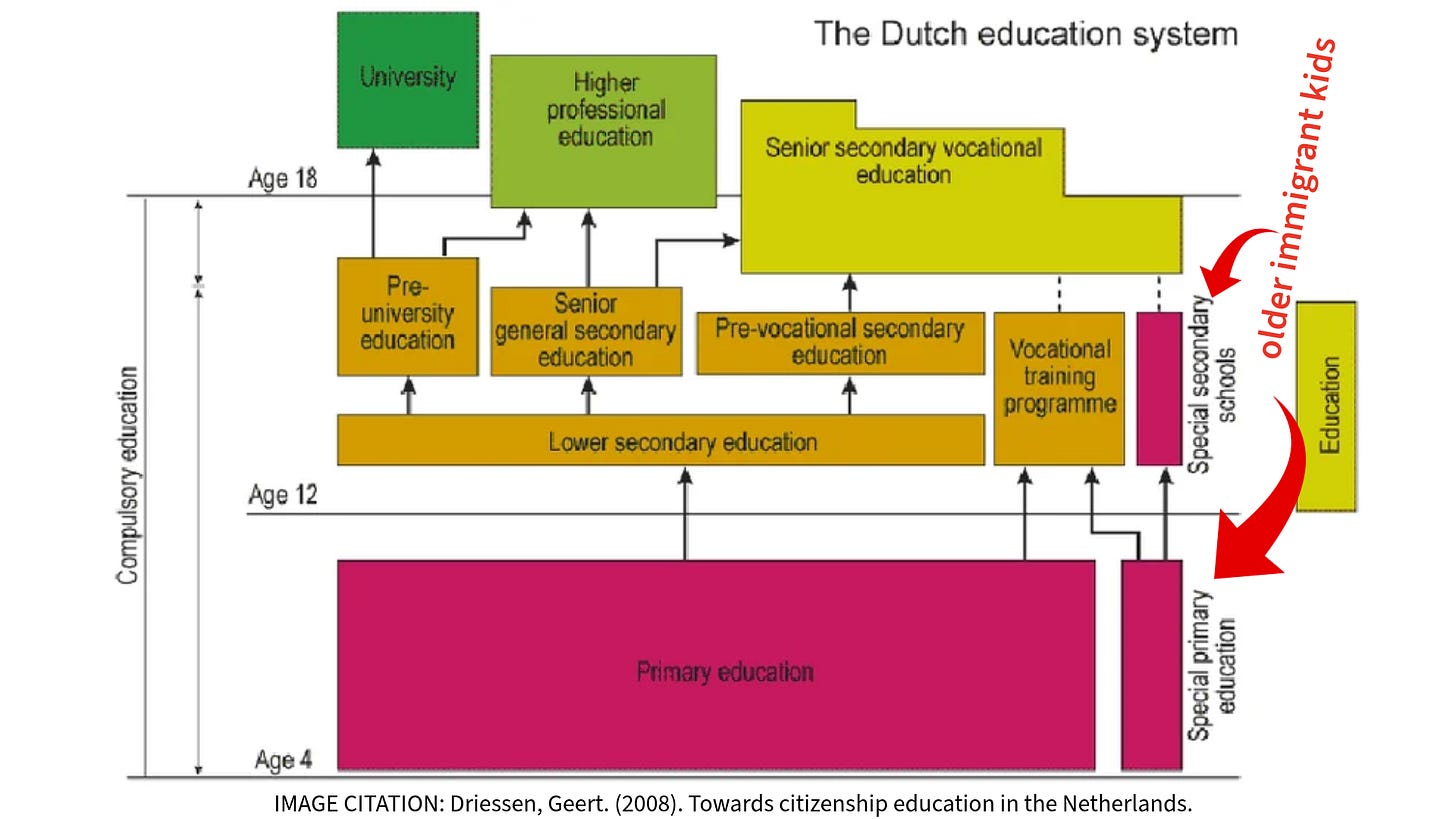
I am here to report that the school buildings are of fine quality, the art supplies color-coordinated, the ceilings fully intact and the windows tall to let in natural light. Netherlands public schools aren’t funded by zipcode, and sending my kid to these schools doesn’t feel like sending her to an under-funded school. It’s a quality-but-not-fancy school. An immigrants-only school. Imagine, America. Soak it in. Let this be so in our country. Let it be so. But I digress. Let me share what I learned about the Dutch school system over our year of navigating it and the pros- and cons- about starting the kiddos at the International School. I’ll start with a diagram of an institutional model that continues to make me laugh out loud, now that I’ve moved past the horrified, wide-eyed stare.
NAVIGATING THE DUTCH SCHOOL SYSTEM WITH OLDER KIDS
When we decided to move to the Netherlands, I was HELLA daunted by their system. Here, you take a look. You’re gonna think you’re looking at the design of a giant diagram of how a factory’s machine works. But no, it’s a diagram of what school children will go to.
Which secondary school you go to holds so much weight, they ask about it on job applications. No matter how old you are. It felt like a giant decision for my kid to just toss her into this machine-chart and say “you’re an immigrant. You will be a practical VoTech worker. That’s that.” Starting at an International School was the only way for our kids to land somewhere teaching in English and teaching them subjects normal for their grade level. Considering we didn’t know FOR SURE if what we were doing was the right long-term choice for us, we didn’t want them to get a whole year behind in the learning basic things on top of the existing gaps in their education because of shit dysfunction of US public schools + the 1.5 kids my kids were online-not-at-all-learning during COVID. And so I cashed out my not-so-big nonprofit 401k and put half of it toward their year at International School.
Last year, as cold winter rain dragged its ass into the domain of spring, we saw “Open Daag” banners posted outside all the giant schools around us. They looked, frankly, quite vibrant. My big kiddo had been, what’s that word?, pretty miserable since we arrived here. I hoped that after a month or two the homesickness would thaw, she’d find a friend or two to look forward to at school, and things would balance out.
Dear reader, it did not. Our kid seemed to have nothing to look forward to outside of our literal house except returning to the US for a visit in the summer, and even that was dicey, what with the fascism and all that.
So, as her 13th birthday arrived and I began to wonder “shit, how does she get from here, on our couch, writing YA novels, secretly watching YouTube videos of miniature artists, and hating everything about the Netherlands, to being a happy, connected human who goes to baking school here in the middle of a country that thrives on baked goods?” So I dove once more into the convoluted system of Dutch education.
In my research, I determined that she would have to make the big wide leap into the public school system and douse herself in learning Netherlands ASAP. The thing about this is that learning Dutch at her age in this system is an entire two year process. And that’s two years that she’s not learning what other students would be learning — here in the Netherlands, among whom she will presumably join in a classroom someday — and in the US if, for whatever reason, we return.
So, we did what any good creative worker would do, and made them both a “this is your life” power point presentation, allowing them to choose a path of delayed reality— aka, one more year at International School—or present-tense linguistic diving lessons—aka, start at the Dutch public schools and we will all try our best to doe normaal for the next five years.
The choice
They both, instantaneously, chose Dutch school. The public secondary school system is hierarchical based on your future labor class (let’s not sugar coat it) and is thematically focused around certain topic areas. For example, one high school for University-bound Dutch kids shares land with the campus of the International School my kids went to. Its focus is Internationalism with a bilingual Dutch/English education. But no, my children were not welcome to go there, ever, the administrator kindly and calmly explained to me in a Zoom call last year, no matter how much Dutch tutoring they received. But, like I said, my older kid has always wanted to be a baker, and my younger kid really wants to be an actor right now. Both of those goals feed through the vocational high school program, of which more than 50% of Dutch secondary school students attend. It is the norm.
TBH, I am literally still paying off my own University debt, sitting here secretly hoping someone who is not anxious about their bills these days might toss a few bucks into my Buy Me a Coffee jar for writing this whole participatory research report—since that degree sure hasn’t paid for itself—so I say hell yes. LFG.
During the two years my big kid is likely to attend the VMBO (secondary school) that feeds into the baking MBO (kind of like jr. college), she will study some classics like math and history, but also will learn baking science and kitchen hygiene. By the time she is 20, she will have training in the economics of running a small business, baking a wide range of European breads and pastries, and can even specialize in super fancy baked goods if she wants. To which I say: hell yes. We will always need bakers and she loves it. Also who can scoff at the cost? Not me. After she’s 16, it’s 1k a year.
How do you get from Immigrant Language School to the Great Dutchie BakeOff?
I’m happy to report, I understood 65% of the Secondary School back-to-school night, thanks to my three months of Dutch language class at the local library and brief English translations the teachers interspersed here and there.
The presentation included a timeline and plan of advisement for students. Sometime mid-year the students will take a Netherlands language test, and based on their language test score + how they do on a math test + how they generally do in school, the teachers will give them the name of the type of focused Netherlands secondary school they will recommend.
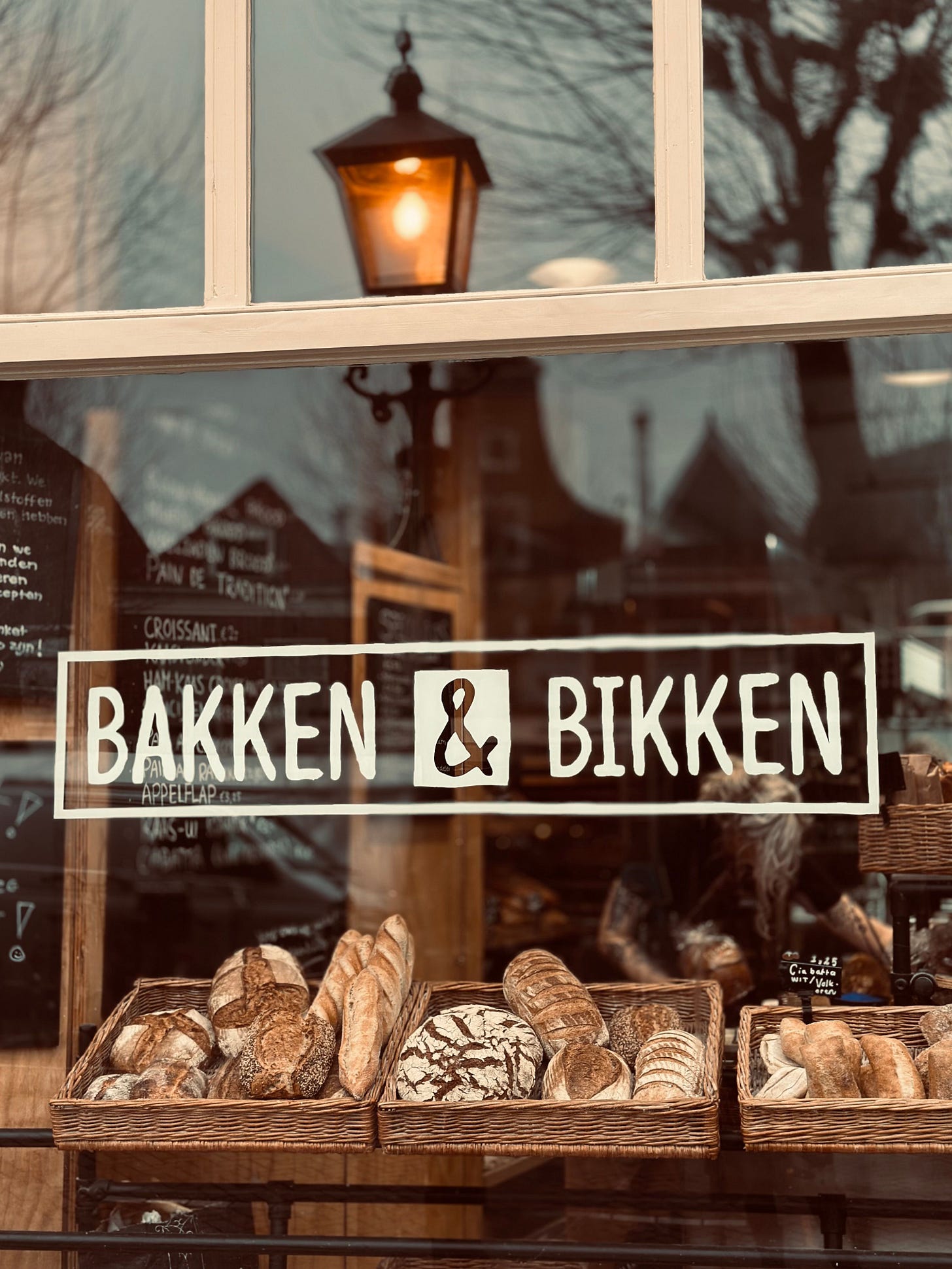
Photo by Inas Isleem: https://www.pexels.com/photo/cozy-bakery-window-display-with-fresh-bread-29793110/
Will the student go to the vocational school with some theory or the vocational school that’s only practical? Or maaaaaybe they will be recommended to go to the school that could land you in University or the equivalent of a good old fashioned state school where you’ll learn something practical, like coding or graphic design or video game production or project management, but will not help you become a lawyer.
They also explained when the Open Days were for the Netherlands-language secondary schools (that icy-rain time of year). We will attend a number of these, the baker-kiddo will decide, and the teachers will coordinate for her to transition out of Immigrant High School into some specialized high school program that NL-born students are about halfway through.
But wait, how IS the immigrant school?
The first time we took the big kid to her public Nederlands school was last spring.
We had booked an appointment to view the school and after the tour, the administrator gave my kid an on-the-spot Dutch language test. Then she said “Okay, you can start next week after break.” I was not ready for the quick change in plans, and tried explaining we had only come for a tour for the next school year, but in the Dutch practical way she said: “you’re planning on staying here, yes? She needs to learn Dutch. Why not start now?” And my kid, to my surprise, immediately said “I’ll do it. I want to start here.”
See, when we toured the school, the administrator interrupted class to introduce the teacher. All the students crowded around the window, trying to see my kid. But they didn’t just stare. They waved. They whispered excitedly. My kid had been miserable at the International School. The courses were significantly more demanding than any 6th grade classroom or, let’s be honest, any non-Harvard-feeder-middle-school in the USA. Rigorous and thorough, the ever-changing online assignments required my kid to independently manage her work. We had never let her have unrestricted access to a device of her own before. It was a real adjustment from the liberal-leaning public school that barely assigns homework at all. She spent 3 -4 hours each night doing homework from a laptop, and after a month or so, she was able to adjust and hang with it.
Many of the lessons she learned in those 8 months I wasn’t taught until college. Never having attended a private high school, and knowing we likely couldn’t afford it for her for long into the future, I was jazzed for her to soak it all up. She started learning Spanish and sort of started learning Dutch. She learned how to write persuasive essays and analyze modern art before trying to mimic it.
But, alongside the rigor was a peer environment that ranged from generally unfriendly to mean-girl-hostile in the tune of homophobia — most of the girls in her class fully stopped talking to her because she IDs as queer and they assumed she had a crush on them. Not like, you’re not invited to the sleepover. More like, can you endure an entire day without any other girl speaking to you? One girl straight up wouldn’t even do group assignments that required them to collaborate. She just left all messages unread. It was mean. When I brought the daily reports of widespread homophobia up with her school mentor (essentially, homeroom teacher), she suggested we provide Lyrrin some support accepting herself. You can imagine my firm-faced “that’s a hard no thank you. May I speak to your supervisor” response? It didn’t go anywhere, so we focused on making our bubble the best bubble we could.
She was unhappy the entirety of our time in the Netherlands during this time. She seemed stuck on the couch, not simply experiencing homesickness, but very much not okay. Then, she walked into this public school that most NL people I talk with literally don’t even know EXISTS in their town, a high-school full of only newly arrived immigrants1, and she came home happy. Her normal, cheery, helpful, flexible, tween-to-teenager self. She said to me, after the 2nd day, “Baba, when I walk into the classroom and sit down, and the person I’m sitting next to says hi to me.”
PEOPLE. The bar is low. It’s so low. And it’s so easy to achieve. Say hi to the people in your proximity.
The first day, as my wife walked with her toward the school entrance, one of the kids who had peeped from the window, said “Oh hi, I think you’re in my class. Let me show you where we meet.” And that was that. She has friends. She knows their birthdays. Most of these peers are Muslim young women who wear head coverings. They can articulate to my daughter the difference between their parents’ perceptions, what they’re taught, what they believe, and the reality of their life alongside queer people, which seems to be generally: “I can’t be gay, but that has nothing to do with you. You’re great.” Some students are refugees from countries like Sudan and Somalia who have moved from one host country to another over the years. Others are from countries experiencing ongoing war or civil conflict like Eritrea, Ukraine, and Syria. Others are from countries with less economic opportunities than the Netherlands, like Vietnam or Montenegro. Despite coming from VERY different cultures and backgrounds, having different experiences of life as children, different religions, they are school friends. She has peers to chat with.
She was only at the new-arrivals class for six weeks, but learned enough Netherlands to be promoted (along with most of her class of students who arrived in the Netherlands after January) onto the 2nd year. Her new school is slightly bigger, her class contains another American whose family left for similar reasons to us, and her friendships are having time to sink in from new to familiar. And the littler one is doing just fine, making friends and learning new ABC’s. We already received communication from the primary school recommending a little support here and there to make up for the lost-learning-years-of-hell from her last US school—because they’re paying attention. Because they have expectations. It’s not too much to ask, and also, it’s a breath of fresh air.
WANNA COLLABORATOR?
If you’re looking for support setting up a new public profile (like Substack) or online shop (like Etsy, Printful, Kickstarter, or Shopify), are looking for a partner in Custom Publishing (aka, turning your ideas into a real live book), or are looking for a thought partner pick-your-brain consulting, I have spots for a few new clients this fall.
You've Got Mail is a message-in-a-bottle newsletter about change. How it feels, how we navigate it, how we work with others to shape our world, and how we make strategic decisions inside it. Here I share decision-making tools, reflection essays, book recommendations, announcements, and stories to illuminate the threads between systems, change, and the lives we live inside it all.